![[personal profile]](https://www.dreamwidth.org/img/silk/identity/user.png)
Geology Liveblog: KABOOM
Jul. 12th, 2019 10:50 amSo, basalts are, like, cool and all. Most of the crustal rocks are basalts, most crustal rocks were basalts at some point, and they can be rather pretty.
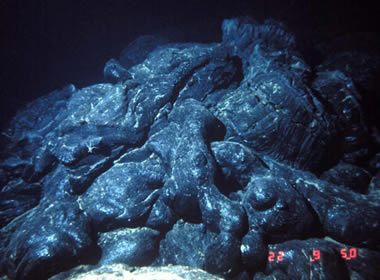 A pillow basalt, which is how they tend to form on the ocean floor. Photograph by NOAA
But basaltic volcanoes lack... a certain je ne sais quoi. They're a bit-- lethargic, let's say. Sure, you can get some pretty basaltic fire fountains, but overall basaltic eruptions aren't particularly high energy. It just tends to kinda dribble out of the volcanoes. (You know those Hawaiian volcanoes that are erupting all the time, but the eruption just involves some magma flowing out of the volcano and down a hill? Those are basaltic.)
For high energy eruptions, you need andesites, dacites or rhyolites, which are higher silica volcanic rock. They may not be pretty (they tend to be fine grained grey-ish things, though rhyolites are sometimes pinkish.)
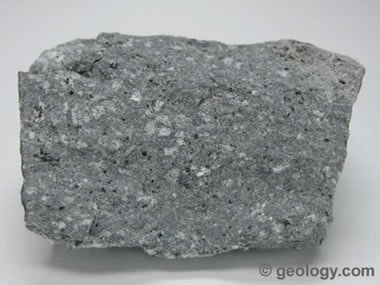 Some andesite.
But the average contintental crustal composition is andesite,
And they go KABOOM when they come out of a volcano.
Some andesite.
But the average contintental crustal composition is andesite,
And they go KABOOM when they come out of a volcano.
The division between andesites and dacites is mostly drawing an arbitrary line along a continuum. But they do have slightly differing mineralogy. Andesites generally have a lot of plagioclase feldspar, and a little bit of more mafic minerals like olivine, pyroxene or horneblende. Dacites are higher silica, and they have Na-plagioclase feldspar, alkali feldspar and some quartz (though there is pretty much always more plagioclase than alkali feldspar). Rhyolites are alkali feldspar, quartz, and tend to be pretty glassy.
So, why the KABOOM? There are two main reasons. One is their higher silica content. The silica content makes them more viscous, both because that's just what silica does, but also because this higher silica content makes the silica form chains and sheets-- which can't really. like. flow very well. With a basaltic eruption, the basalt is un-viscous enough that it doesn't take much pressure to let it out, so the pressure never really builds. You get just enough pressure for the basalt to push itself out (except for fire fountains, but even they are pretty chill), and then it rolls merrily along it's way. But for your andesites, even when they are melted magma they're still pretty viscous. And rocky. So it takes a lot of energy to erupt them. So the pressure tends to build. And build. And build. And maybe they're might be enough for an eruption now, but due to geological vagaries, it doesn't happen yet. So the pressure builds some more. And some more-- and KABOOM.
But the andesites have another explosive secret. Because most andesitic etc. volcanoes are subduction zone volcanoes. Remember how subduction zone magmas melt because of water (and CO2) coming off the subducting plate? So, these magmas have a lot of gas trapped in them. A lot. And quite big bubbles of it too! Enough to build absurd pressures if they got trapped inside something like, say, a magma chamber.
Andesitic volcanoes are the geological equivalent of a shaken up can of coke. If the coke was superheated and filled with razor sharp shards of glass.
As coke tends to be.

