Geology Liveblog: How To Look At Rocks
Jul. 8th, 2019 12:18 pm![[personal profile]](https://www.dreamwidth.org/img/silk/identity/user.png) wolffyluna
wolffyluna(aka, the post with the pretty pictures and videos.)
So, you're a petrologist on the go, and you've got rock that you want to know what minerals it has.
How do you find out what minerals it has in it.
How do you look at your rock.
There are three main ways you can look at a rock.
The first is by looking at a hand sample. Which is just... looking at a rock with your eyes. Maybe with a hand lens as well. It's main advantages it's that it's a very portable technique. You just need your happy self, and maybe an eensy hand lens you can fit on your lanyard, and away you go. It's great out in the field.
It's main problem is that only really works on coarse grained rocks. If it's fine grained, you are out of luck.
Also, a lot of minerals can look similar in a hand sample. Even ones that you wouldn't think looked similar at all.
Take pyroxene and quartz. Very different minerals that you really don't want to mix up when you're trying to work out what a rock is.
 Clinopyroxene (diopside, specifically,) photographed by Rob Lavinsky.
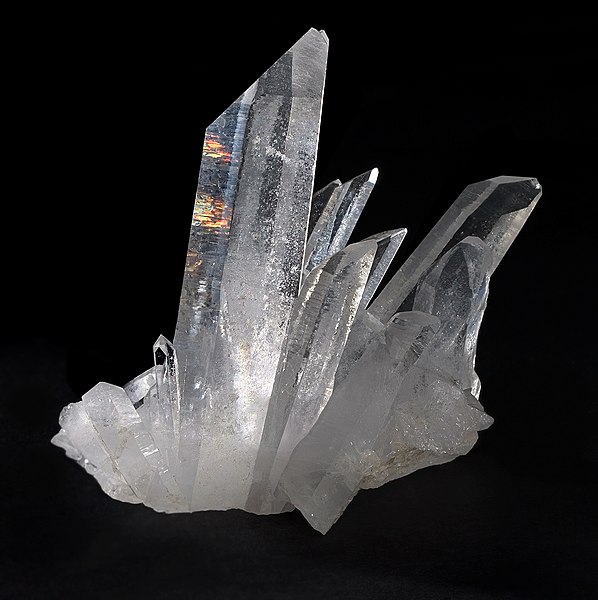 Quartz, by JJ Harrison.
You'd think these are very different looking, right? Nope! Because in a hand sample, they often just look shiny.
Another technique is taking it to a lab. Fire lasers at it (or ion beams, those get used sometimes.) This is great, you can get very detailed measures of a mineral's chemical composition, and all sorts of other good stuff.
It's main disadvantages are that you... need a lab with fancy equipment to do it. (So you've probably had to look at some hand samples, to decide which to ship over to the lab.) And it's a teensy bit destructive. If you're looking at a common rock, it's basically non-destructive, but this whole process give meteorite geologists hives because of oh my god it's so destructive.
Then there is microscopy. If you take a section of rock, slice it thinly, glue it to a microscope slide, and then grind it down even more thinly, most of the minerals become transparent, so the light from the microscope can pass through them. So now, you can actually see those goddamned fine grained minerals that your hand lens was no help for.
Microscopy is an elegant weapon, for a more civilised age-- in other words, people don't use it much anymore. Firing lasers at things gives you more data, anyway. It gets used in a teaching context, because it let's people deal with minerals concretely, without having to deal with hand samples all the time.
So, microscopes.
Petrological microscopes are different from biological microscopes in a few different ways.
- The light from them is always polarised. It can either be polarised once (plane polarised light, or PPL), or polarised twice (cross polarised light, or XPL.) Generally you can swap between the two on the fly by pulling the cross polarising thing in and out.
- The stage rotates. Because there's a lot of useful mineralogical information that's only obvious if you can spin your slide. (Pro tip: Don't be like me, and spin too fast. You will get dizzy.)
Both PPL and XPL get used because they give you different information about a mineral. (Technically, you should always look at things under PPL first, then XPL.)
PPL gives you:
- Colour: A lot of the time, when a mineral is cut thin enough to be seen though, even if a chunk of it would have a colour, it appears colourless. But some particularly strong coloured minerals do have a distinct colour in PPL. Garnet is a good example (which I unfortunately cannot find a picture of in PPL) as is glaucophane (aka the thing that makes blueschist blue.)
 Photograph by Ruth Siddall.
 - Pleochroism: Related to colour. Some minerals change colour as you change the angle you're are looking at them, ie by rotating the stage. Not all minerals have this, but it can be a useful way of distinguising otherwise similar looking minerals. Can be a pain, because it can sometimes show up in XPL and get in the way. Glaucophane is also pleochroic, it changes from blue to purple when you rotate it.
 Photography by Ruth Siddall.
 - Relief: Some minerals-- stand out more. Have thicker outlines. Look taller. Kinda hard to describe.
- Cleavage: Because of their chemical structure, some minerals get crack-like things at distinctive angles to each other. In theory, this is very helpful. In practice, a lot of the time you can only see one set of cleavage if at all.
- Fracture : Sometimes grains of minerals get broken. That's fracture. Distinct from cleavage.
XPL gives you:
- Isotropy/Anisotropy: Isotropic things have the same properties in all crystal orientations, and look black under XPL. Glass and garnet are common examples.
- Birefringence : So, under XPL things look coloured, but generally different colours to their colours under normal light. What colour they look like depends on how thick they are cut. Generally high order birefringence look like if Lisa Frank designed a mineral. Low order birefringence things look kinda grey. It's a spectrum more or less.
 The middle bright purple thing is olivine, which has a fairly high birefringence.
 Plagioclase, which is low order, and also has a feature we will talk about later called twinning.
 - Extinction Angle: Every mineral that isn't isotropic will, as you turn it, appear black every 90 degrees when looked at under XPL. This is called extinction, and the extinction angle is what the angle it goes extinct at compared to it's cleavage. Extinctio can also be undulose, which means it goes across the crystal in a wave as you rotate it.
- Twinning : is when there is a difference in crsytal orientation within a single crystal. You can sometimes see it in PPL, but it's most obvious in XPL, because different parts of the one crystal will go extinct at different angles. Here's a video of it in plagioclase. (CW: Video is spinning, and there is also some slow flashing.)
And that's microscopy!
Quartz is my bête jaune pâle.
People will tell you that quartz is, in and of itself, distinctive in thin section microscopy. They will tell you that nothing else is quite that some cream colour in XPL as quartz.
They are... okay, it would be unfair to say they are 'lying'. But.
Quartz's main distinguishing feature is it's lack of distinguishing features. It is colourless and incredibly low relief in PPL. In XPL, it has a very low birefringence that sometimes looks cream coloured. Sometimes Sometimes it undulose extinction, to give a small piece of excitement in your dull life.
Sometimes you spend several minutes staring at it, because it's relief is so low it can be hard to tell if something is multiple quartz grains, or some sort of feldspar with very 'chunky' twinning.
The only nice thing quartz has ever done to me is be in a thin section quartzite in an exam , which is at least easy to describe quickly.


